Sunrise over the Port of Tacoma with the 11th Street Bridge and Mt. Rainier in the distance.
The Tacoma, Washington area was my home for nearly 5 years. However, my interest in photography had taken a back seat to my newly-started career in the military. As a result, I never got the chance to capture properly, the beauty of the area.
So when I took a one week vacation recently, to stay with friends in Tacoma, I made it a priority to capture at least a few worthwhile images. This wasn't a photography trip per se, so I didn't pack a full kit, nor did I want to. The trip was primarily to spend time with friends, I only brought along one camera and a scant few accessories.
I chose to bring the Sony RX1RII because of it's compact size, yet astounding full-frame 42 megapixel resolution. The limitations were limited only to the 35mm focal length of the fixed lens. However, after a week of shooting photos with only one focal length, I was pleased to find that I didn't feel it hindered me in so far as the type of photography I was shooting.
I hope you enjoy the resulting images and help support my art by making a small donation via Paypal. Thanks!
Driftwood along the shore at Dash Point State Park
Seashells lay on a piece of driftwood.
There are far more rainy, wet days in Washington than there are sunny days. However, I find there's plenty of beauty to be found in the wet, gloomy days.
Power Station on 21st Street in Tacoma, Washington
The changing colors during the first days of fall.
Latitude and longitude
A quirky display at a supermarket in Tacoma
The bridge on Hwy 509 crossing Foss Waterway into Downtown Tacoma
Port of Tacoma Railyards
Sunset at Titlow State Park
Downtown Tacoma
Tacoma Narrows Bridge
Historic Stadium High School, Tacoma, Washington
A long seagull at Fireman's Park in Tacoma, Washington
You might be able to say that the Sony A6000 is what put me on the YouTube photographers map. As of today, our "Top Ten Reasons to Buy a Sony A6000" has had close to 200,000 views on YouTube. I personally know of at least a dozen people who purchased a Sony A6000 based on my recommendation including two pros! At one time I owned two A6000 bodies and they were my first choice for military photography in Korea (after I made the switch to E Mount mirrorless). I know the A6000 intimately, some of the best photos I've ever taken were with the A6000, which made the decision to sell my A6000 in order to upgrade to the A6300 extremely difficult. So why sell and upgrade?
The main reason I've decided to upgrade to the A6300 is for the 4K video capabilities. I've migrated nearly all my video productions to 4K and the A6300 is one of the best performers when it comes to 4K video. It has more customization features for video like S-Log and other picture profiles to give shooters a more cinematic look and more control in difficult lighting conditions. The A6300 can also shoot at 120fps in HD which allows for nice and smooth slow motion captures. Another reason is that I want to continue to have an APS-C E Mount camera in my inventory for sports, wildlife and any other photography which would require the impressive 11 frames per second (same as the A6000). My Sony A7II and A7RII can only manage 5 frames per second. The auto focus has been improved over the A6000 with 479 phase detection points which covers almost the entire frame. In addition to the fast burst mode, an APS-C sensor gives me a 1.5 crop factor which means extra reach with my zoom lenses. Of course, I can shoot in APS-C mode on my A7's but I want to be able to combine the crop factor with the fast burst mode.
A secondary, yet important factor in determining my decision to upgrade to the A6300 was the more robust built of the body. The difference in the quality of the build of the body was noticeable from the first moment I held an A6300. The A6000 is definitely more plastic feeling than the magnesium alloy body of the A6300 (thanks Captain Obvious). The A6300 is also dust and moisture resistant, an issue that I had some experience with the A6000. There are some other improvements over the A6000 that appeal to me, like the improved EVF, but that wasn't really a big deal since I never had any complaints about the EVF in the A6000.
Sony A6000 pictured above with a Mamiya 645 lens mounted with an adapter.
Sony A6000 pictured with a Zeiss 16-70mm lens and battery grip.
Why not the A6500?
Simply put, I didn't feel that the A6500 offered anything over the A6300 for the type of photography/videography that I do. The A6500 offers a touch screen which is mostly used to for touch AF, this doesn't real appeal to me at this time. The A6500 offers a bigger buffer (much bigger) that the A6300, but I never really had an problems with the buffer on my A6000 and the buffer on the A6300 is similar (the buffer is how many pictures you can take in burst mode before the camera needs to "catch up" to record the images to the memory card). When I shoot sports I might shoot 8-10 shots in a burst. Granted, I've been told that the buffer on the A6500 is just as good as on the new A9, and that makes it really tempting, but I just don't shoot enough action and sports to justify the additional expenditure. And lastly, the A6500 features in body, 5 axis stabilization, however, when I shoot video these days, I almost always mount my camera on my Beholder MS1 gimbal stabilizer. And besides, most of the lenses I use for video have optical stabilization already. Naturally, any additional stabilization would be beneficial, but after watching a number of YouTube videos, I didn't feel that the in body stabilization was a deal breaker. Not to mention, if I really want more stabilization, I can shoot with my A7II or A7RII, both of which have the 5 axis stabilization.
Price
The difference in price between the A6300 and A6500 is fairly significant. A brand new Sony A6300 is listed for around $946 USD, while an A6500 can be had for $1398 USD. However, I like to buy used when I can and I've been seeing "like new" A6300's on eBay for the high $700's. When I factor in the $365 I got for my used A6000, the out of pocket cost is extremely reasonable.
Conclusion
When the A6500 was announce, just months after the A6300, I thought that the improvements must be significant enough to justify the quick succession of releases. Some are significant, the buffer for example, but after doing my research, the improvements weren't enough for me, that's not to say the same is true for other photographers. I'm sure there are many who will love the in body 5 axis stabilization (maybe they don't have other camera bodies that have that feature like I do?) or the touch screen. But the price difference combined with the type of photography that I do pointed me to the A6300.
I'm leaning towards picking up the Sony 16mm f/2.8 pancake lens as it looks to be a fantastic lens for video. True, it's only 2mm wider than my 18-105mm however, it's small, which means it will work better with my gimbal. I have other small lenses that work well with the gimbal (the gimbal needs to be balanced, it's easier to do it with smaller lenses, in fact, it's impossible to balance the gimbal with lenses that are long and/or front heavy) like the 35mm f/2.8 and 28mm f/2 but I like the option of having a wider lens as well.
Adding the A6300 will give me 4K video capabilities along with numerous camera bodies in my inventory, the quality of the images it can capture are on par with ANY camera body in it's category.
Below are a number of images I've captured with my A6000 over the past few years and some more images of the A6000 itself. Goodbye A6000, it's been great!
On the Southern edge of the Arizona desert city of Tucson lie the Pima Air and Space Museum, one of the best aviation museums that I have ever been to, granted, I've only been to 4 or 5, but they were all top notch museums (like the Boeing Museum in Seattle). It's directly across the street from Davis-Monthan Air Force Base and it's infamous Air Force Boneyard and can be see from Interstate 10. If you're ever in the Tucson area, I highly recommend it. Be warned, however, it's not cheap; $15.50 for adults, $12,75 for seniors and military. When did museums get so expensive?
I happened to be passing through Tucson, on my way to Phoenix, to pick up a complete studio lighting kit that my good friend Kevin offered to give to me. Kevin is a former professional photographer turned airline pilot and has been very supportive of my continued efforts in photography. He's had this set of lighting gear sitting in various garages for years. He has been watching my videos and noticed that I use speed lights, which prompted his generous offer.
The set includes a total of 4 Hensel studio strobes; two each of the Integra 500's and two EHT strobes (1200's I think) with a battery power pack, as well as a complete modifier kit with stuff like soft boxes, beauty dishes, reflectors, stands, heck, he even gave me some sand bags! Needless to say, this was a MAJOR hook up. I hope he knows how grateful I am. Yes, I paid for dinner and brunch the next morning but my gratitude goes much deeper than that. I am sure he could have tried to sell it all but instead he gave it to me!
This lighting kit was way too heavy and included too much gear that it wasn't practical to have it shipped, therefore, the only option was a road trip. The Santa Teresa, New Mexico to Phoenix, Arizona drive takes about 5 hours and 30 minutes. Not too bad really, I also drive a Prius. It's 50 MPG fuel efficiency equals about a tank of gas each way. This was a small price to pay considering what I was going to go pick up!
The weekend road trip also provided me with several outstanding photographic opportunities, the first of which was the Pima Air and Space Museum. I took the scenic route home, traveling on Highway 60 East out of Phoenix and then hopping on Highway 70 (The Old West Highway), along the way I happened upon a beautiful oasis at the Boyce Thompson Arboretum State Park, which provided my second photographic opportunity which I'll be posting about in my next blog. Stay tuned!
Back to the Pima Air and Space Museum.
I only brought 3 cameras and 2 lenses with me on the trip; the Sony RX1RII (fixed Zeiss 35mm f/2 lens), A7RII with Zeiss 85mm f/1.8, Zeiss 50mm Planar f/2 (Leica M mount) and I brought my Polaroid 250 land camera with one pack of instant film.
The air museum was a perfect spot to showcase the incredible resolution and capabilities of the RX1RII and the A7RII. You'll see the photos below and be sure to take notice of the 3 "crop" samples I included to get an idea of exactly how much you can crop an image in these 42mp cameras and still end up with a high resolution image.
Enjoy!
If you enjoy my images please consider making a small donation to assist with my continued photography projects! Thanks!
The following images were shot with the Sony A7RII. Scroll down for the RX1RII images.
US Interstate 10 looking West, somewhere in New Mexico
Above is the original, uncropped image shot with the A7RII and Zeiss 85mm lens. Check out the crop below and wow, just amazing clarity in a 90% crop!
Above, again this is the Zeiss 85mn lens and below you can see a crop that's even more than 100%!
And last one, again, the resolution is amazing.
Grumman J4F Widgeon Boat Plane
Jet intakes of the Grumman RF-9J Cougar
View of the Pima Air and Space Museum, looking North from the second floor of the B-17 hangar/exhibit
B-17 Flying Fortress
B-17 Flying Fortress
North American RA-5C Vigilante
McDonnell F2H-2P Banshee
Lockheed Constellation
Douglas C-118 Liftmaster Air Force one
Douglas C-54D Skymaster
Avro AEW.2 Shackleton
Avro AEW.2 Shackleton tail section
Boeing EB-47B Stratojet
Pima Air and Space Museum
Convair B-58A Hustler
Mig Alley
Mig-29
Foreground MI-24D Hind Attack Helicopter, A10 Warthogs landing at Davis-Monthan Air Force base can be seen in the background.
MI-24D Hind Attack Helicopter
Are these East German markings on the Hind attack helicopter.
Sony RX1RII
Martin PBM Mariner
North American F-107A
Republic RF-84F Thunderflash
Jet intakes of the Grumman RF-9J Cougar
Lockheed S3B Viking
Grumman F14A Tomcat
McDonnell Douglas F4-E Phantom II
Waco ZKS-6
Wright Flyer
Waco RNF
Model B17 Flying Fortress
Bombadier area B-17 Flying Fortress
Inside the fuselage
B-17 ball turret with twin 50 caliber machine guns
B-17 dioramas
Douglas C-124C Globemaster II
Boeing KB-50J Superfortress
Aero Spacelines 377-SG Super Guppy. I've actually seen one of these flying near Biggs Army Airfield in El Paso, Texas. It flies really slow and is definitely a sight to behold.
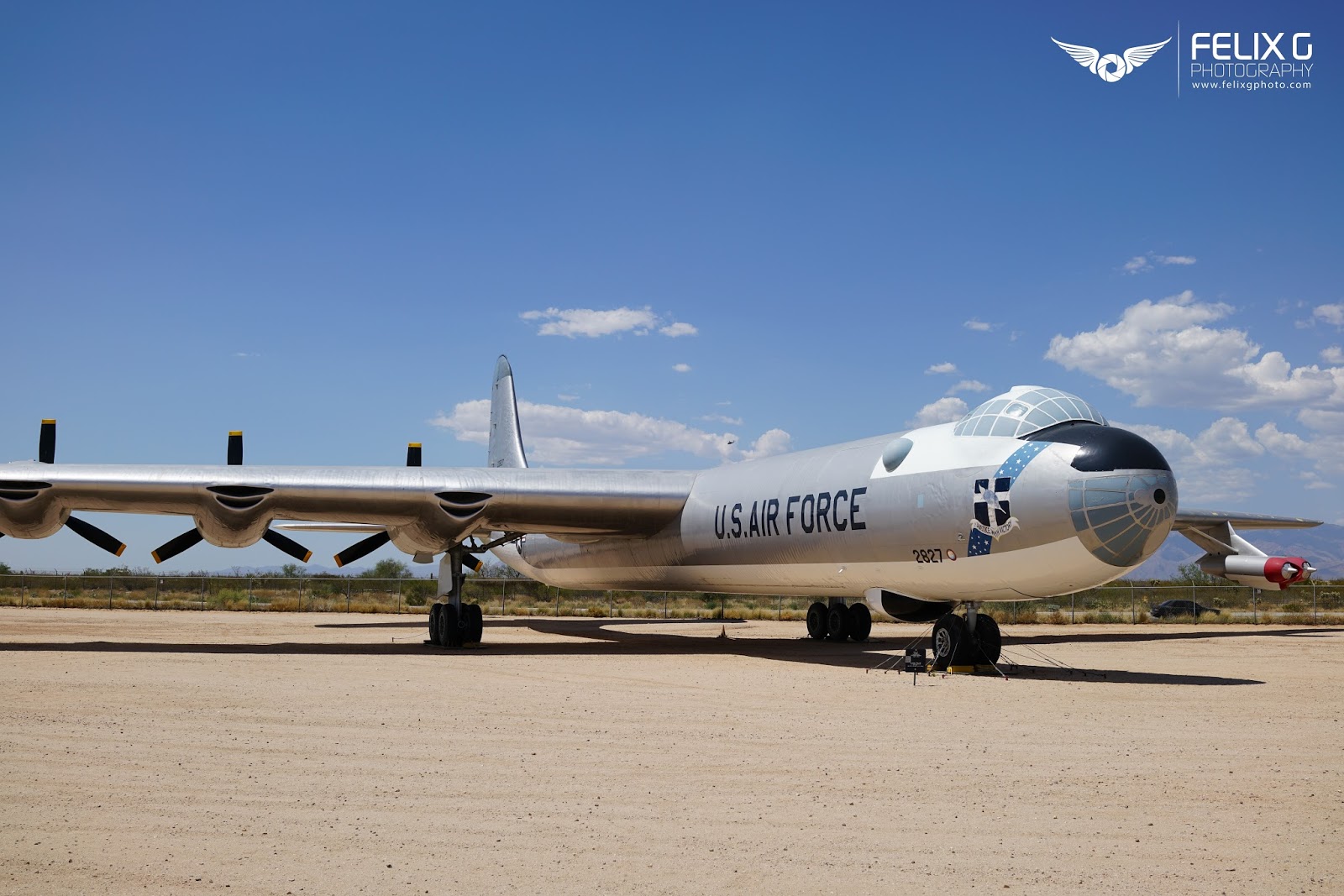
Convair B-36J Peacemaker
Below: a few planes, including this Beechcraft, have been painted by artists.
A view of the Hawaiian Islands from high above the earth. Just kidding, this is a model globe that can be found inside the Space portion of the museum.
And here are a couple shots taken with the Polaroid 250 Land Camera with FP-100C pack film.
I hope you enjoyed the photos. Obviously, both cameras are extremely adept at this type of photography and the 42 megapixel sensors provide medium-format-like resolution. Stay tuned for more!